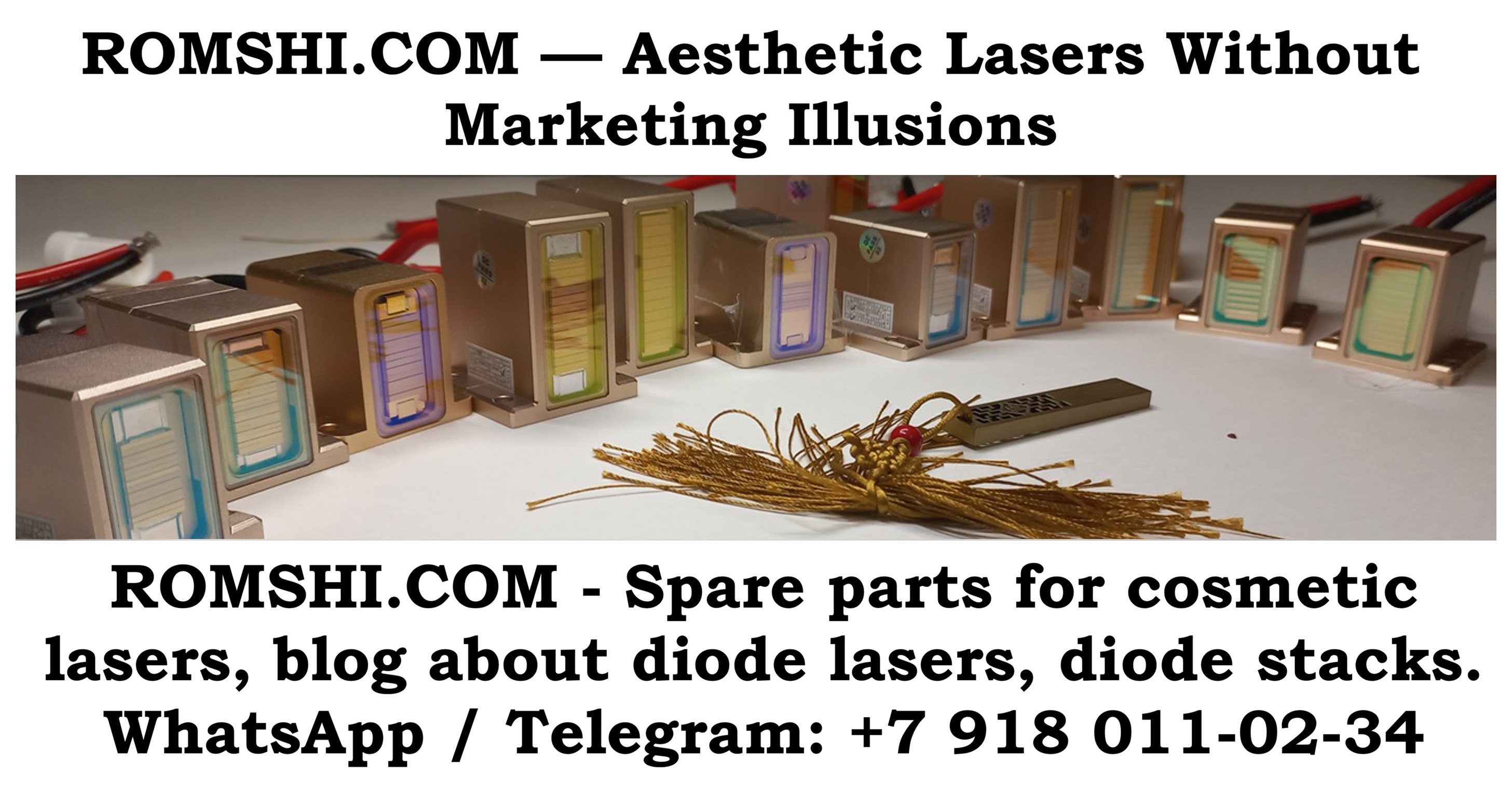


Expert ROMSHI talks about lasers
Short answer: No, you cannot perform laser hair removal directly on or over a tattoo. It's risky for both the tattoo and the skin. However, around the tattoo — yes, with caution.Why does the laser "dislike" tattoos?
The laser (especially the 808 nm diode) works on the principle of selective photothermolysis: it targets melanin (pigment) in the hair and heats it up, destroying the follicle.The pigment in tattoos also strongly absorbs laser light (especially black and dark colors). The laser "confuses" the tattoo ink with hair melanin and starts heating it.Possible consequences:
- Fading or distortion of the tattoo (ink breaks down, colors change or pale).
- Burns, blisters, or scars on the skin.
- Intense pain during the procedure (the tattoo heats up more).
- Changes in skin texture or hyper/hypopigmentation.
All clinics and specialists confirm this: hair removal lasers are not designed for tattoos, and even accidental exposure can ruin the design.What do salons do?
- They cover the tattoo (with tape, white pencil markup, or simply avoid it, leaving a 1–3 cm margin).
- Treat only the skin around the tattoo.
- Remove hair on the tattoo itself using other methods (shaving, waxing, sugaring).
If the tattoo is large and covers the entire area — laser hair removal is not done there at all.Best plan of action
- If you're planning a tattoo — complete a full course of laser hair removal in that area first, wait 1–2 months, then get the tattoo.
- If the tattoo is already there — hair removal around it is possible, but on the tattoo itself — only traditional methods.
- If you want both smooth skin and a tattoo in the same area — first remove the tattoo with a laser (specialized for tattoo removal), then do hair removal.
Alternatives for hair on tattoos
- Shaving (safest and cheapest).
- Depilatory creams.
- Waxing/sugaring (painful and temporary).

The Key Role of Melanin in Laser Hair Removal Laser hair removal (especially with 808 nm diode lasers) works on the principle of selective photothermolysis. This means the laser selectively targets the hair while sparing the surrounding skin.
The "secret identifier"? Melanin — the pigment that gives color to both hair and skin.Why is melanin so important?Melanin strongly absorbs light in the 700–1100 nm range. The 808 nm wavelength hits the peak absorption perfectly.
- In hair (especially during the active growth phase — anagen): High concentration of melanin in the shaft and follicle (bulb and bulge).
- In skin: Lower concentration (especially in lighter skin types), evenly distributed in the epidermis.
What happens during a laser pulse?
- Light penetrates the skin (it's relatively transparent to 808 nm).
- Melanin in the hair absorbs the energy → converts it to heat (70–100 °C).
- Heat spreads along the hair and destroys the follicle (growth cells).
- Skin stays cool — minimal melanin means minimal heating.
Absorption spectrum of melaninGraphs show why 808 nm is optimal:
- High absorption by melanin
- Low absorption by water and hemoglobin (blood)
This minimizes skin and vessel heating.Important nuances
- Dark hair on light skin → Maximum contrast = best selectivity and results.
- Light/blonde/gray hair → Little melanin → laser "doesn't see" the hair well.
- Dark skin → More melanin in epidermis → higher burn risk. Longer wavelengths (e.g., Nd:YAG 1064 nm) or strong cooling are used.
- Modern diode lasers feature powerful skin cooling for extra protection.
In the end, the laser doesn't "think" — it simply follows physics: energy goes where there's more melanin. That's what makes the procedure effective and relatively safe!Ready for smooth, long-lasting results? Romshi — Manufacturer of 808 nm diode stacks
In most laser devices (especially CO2 laser cutters/engravers and some cosmetic/medical lasers), water acts as the coolant for the laser tube or radiation source.
Changing it once a month is a common recommendation, particularly for simple open cooling systems (like a bucket with pump or basic chiller). Here's why regular changes are essential: Prevent bacteria, algae, and microorganism growth
Warm, dark water creates perfect conditions for bacteria and algae "bloom" (green slime). Within a month, it can cause contamination, bad smells, and slime that clogs hoses, pumps, and tube channels. Avoid blockages and reduced water flow
Contaminants slow circulation. Poor flow leads to tube overheating, drastically shortening its life (from years to weeks), lowering beam power, and causing unstable operation. Prevent scale and deposits
Even distilled water accumulates impurities over time (from air, dust, or dissolved particles). These build up on tube walls, reducing heat transfer. Maintain cooling efficiency
Clean water removes heat better. Dirty water causes overheating, power loss, and risk of damaging expensive parts (a laser tube can cost thousands!).How often to change?
- Simple open systems: Every month (or sooner if water looks cloudy).
- Closed chillers (e.g., CW-3000/5200): Usually every 3-6 months, but monthly in dusty environments or heavy use.
Always use distilled or deionized water to minimize deposits!
Skipping changes can lead to poor cut quality, full tube failure, and costly repairs. It's simple maintenance that greatly extends your machine's life! Check your model's manual for exact guidelines.Manufacturer of diode stacks 808nm. Supplier of laser hair removal machines and spare parts!
www.romshi.com | +79180110234 Sale laser spare parts. Shipping from China
It's Often a GOOD Sign!Yes, feeling a mild tingling sensation (described as light burning, "pinching," or the classic "rubber band snap") during 808 nm diode laser hair removal is completely normal — and in most cases, it's a positive indicator that the treatment is working effectively.
However, it's crucial to understand the difference between "good" tingling that signals success and excessive discomfort that may indicate a problem.Why Does Tingling Occur and What Does It Mean?1. Thermal impact on the hair follicle
The 808 nm laser energy is selectively absorbed by melanin in the hair shaft → heat is conducted directly to the follicle → the temperature rises to 70–75 °C or higher.
This intense heat damages the hair growth cells (matrix and bulge stem cells), preventing future regrowth.
Tingling = proof that the energy has reached the target and the follicle is being properly heated.2. Reaction of skin nerve endings
The surrounding skin warms slightly (typically to 45–50 °C). Sensory nerve endings detect this heat, producing the tingling or mild burning sensation.
When the feeling is tolerable and brief, it confirms that the energy level is appropriate and the treatment is on track.3. Individual sensitivity factors
Tingling is usually stronger in sensitive areas (bikini line, underarms, face) or when treating coarse, dark hair — because higher melanin content absorbs more energy and generates more heat.When Is Tingling a Good Sign of Effectiveness?
- Sensations are mild to moderate and disappear immediately after each flash.
- The treated hair is dark and thick (high melanin = excellent absorption).
- Hair begins to shed naturally 1–3 weeks after the session.
- The cosmetologist uses optimal settings — sufficient energy combined with powerful contact cooling.
When Is Tingling a Warning Sign?
- Severe pain or prolonged burning — energy is set too high → increased risk of burns, blisters, or pigmentation issues.
- Tingling occurs on very light, red, or gray hair — the laser has little to absorb, so sensations may come from skin overheating rather than follicle targeting.
- No effective cooling on the handpiece — the skin heats unnecessarily, raising discomfort and burn risk without improving results.
Expert Conclusion: Balance Is KeyModerate tingling is a reliable sign that the procedure is effective. It tells you:
"The laser energy successfully reached the follicle and is heating it to the therapeutic temperature."On the other hand, no sensation at all (especially on dark, thick hair) often means the parameters are too conservative and the treatment may be underpowered.The ideal diode laser experience combines:
Light, tolerable tingling + strong contact cooling (sapphire tip cooled to –5...–10 °C) → maximum comfort and maximum effectiveness.Results do not depend on "the more pain, the better." True success comes from precise, individualized settings that destroy follicles safely and comfortably.If a client experiences intense pain, the professional should immediately lower the energy or enhance cooling — safety and comfort always come first, while still achieving outstanding long-term hair reduction.
Let’s talk real numbers that directly impact your salon’s bottom line. When choosing between IPL (Intense Pulsed Light) and a high-quality 808 nm diode laser, the key difference isn’t just in treatment effectiveness — it’s in long-term operating costs, downtime, and overall profitability.IPL Systems: High Ongoing Consumable CostsIPL devices rely on xenon flash lamps (or replaceable cartridges/handpieces) that have a limited lifespan:
Average resource: Typically 100,000 to 500,000 flashes per lamp (professional salon-grade systems often on the lower end; home devices may claim higher but deliver less power).
Replacement frequency: Every 6–18 months in a busy salon, depending on daily procedure volume.
Cost per replacement: $800–$2,000+ for a new lamp, cartridge, or handpiece (including labor if needed).
Over 5 years: Expect 4–10 replacements, totaling $5,000–$20,000+ in consumables alone.
Add to that:
Frequent downtime during replacements.
Potential service calls and calibration after each swap.
Lower energy consistency over time, which can lead to more sessions per client (and dissatisfied customers).
808 nm Diode Laser (Premium Quality Stack): Minimal Ongoing CostsHigh-end diode lasers use solid-state laser bars (stacks) that are built to last:
Resource: 10–50 million flashes (commonly 20–30 million in professional machines with brands like Coherent or Dilas bars).
Lifespan: One stack easily handles 5–10+ years of intensive salon use.
Replacement needed?: Rarely — often only once per decade or never within the machine’s operational life.
Over 5 years: Virtually zero additional consumable costs (just routine maintenance like water filters).
Additional advantages:
No frequent lamp changes → minimal downtime.
Stable power output throughout the lifespan → consistent results, fewer touch-ups needed.
Lower service requirements overall.
Real-World Profit Calculation ExampleAssume a busy salon performs 10 full-body hair removal sessions per day (average ~2,000–5,000 flashes per session, depending on spot size and area):
Annual flashes: ~7–18 million (over 300 working days).
IPL: You’d burn through multiple lamps yearly → $3,000–$10,000+ annual consumables.
Diode 808 nm: A single quality stack covers multiple years → annual consumable cost near $0.
Result over 5 years? You could save $20,000–$50,000+ on replacements, service, and lost revenue from downtime.More Procedures = Higher Profit + Happier Clients
Diode lasers deliver faster treatments (larger spot sizes, higher repetition rates) → more clients per day.
Superior long-term hair reduction (often 80–90% permanent after 6–8 sessions vs. IPL’s variable results) → better reviews, repeat business, and referrals.
Painless experience with built-in cooling → higher client satisfaction and retention.
Invest once in a reliable 808 nm diode laser stack (from trusted manufacturers like those using Coherent or German Dilas bars), and forget about constant expenses eating into your profits. The upfront cost pays for itself quickly through savings and increased revenue.At Romshi, we specialize in premium 808 nm diode stacks engineered for maximum durability and efficiency. Need stacks, handpieces, repairs, or full systems? Contact us — we’re manufacturers dedicated to helping salons maximize profitability!
High procedure speed: 808 nm diode lasers operate with a repetition rate of up to 10–20 Hz, allowing large areas (back, legs) to be treated in 15–30 minutes, compared to 1–2 hours with IPL.
- More stable energy: The diode laser delivers consistent power throughout its entire lifespan, unlike IPL where energy decreases as the lamp wears out, reducing effectiveness.
- Fewer consumables: Apart from the stack, diodes have virtually no consumables — only water filters every 6–12 months (costing $50–100), versus expensive lamps and cartridges in IPL.
- Better penetration depth: 808 nm penetrates up to 4–6 mm deep, effectively targeting even deeply located follicles, which IPL often fails to achieve due to its broad spectrum.
- Fewer sessions per course: Clients typically need 6–8 sessions with a diode laser versus 8–12 with IPL for similar results, increasing client loyalty and turnover.
- Year-round operation: The 808 nm diode is safe even on lightly tanned skin (with proper settings), while IPL is strictly contraindicated on tanned skin due to burn risks.
- Lower power consumption: Diode devices consume 1–3 kW, while IPL systems often use 5–10 kW, significantly reducing electricity bills in the salon.
- Ease of maintenance: The diode stack does not require calibration after each client or frequent adjustments, unlike IPL where the spectrum and energy need constant monitoring.
- Higher average check: Thanks to its premium status and better results, salons can charge 20–50% more for diode hair removal than for IPL.
- Longer equipment lifespan: A high-quality diode laser lasts 10–15 years under intensive use, whereas IPL devices often require full replacement or major repairs after just 5–7 years
In the world of professional laser hair removal, one wavelength stands out above the rest: 808 nm. It's not just a number — it's a proven optimal balance that delivers safe, effective, and long-lasting results.
Many manufacturers and clinics call 808 nm the "gold standard" for diode lasers in hair removal, thanks to its ideal combination of penetration depth, melanin absorption, and minimal risk to the skin. Let's dive deeper into why this wavelength has earned such recognition.Perfect Melanin AbsorptionThe 808 nm wavelength is optimally absorbed by melanin in the hair follicle while minimally interacting with melanin in the surrounding skin. This provides:
Deep penetration — the laser beam reaches the follicle directly, destroying it at the bulb and stem level, leading to long-term hair growth reduction.
Reduced risk of burns and discomfort — especially on darker skin tones (Fitzpatrick scale IV–V, and in some cases VI). Unlike shorter wavelengths, 808 nm scatters less in the epidermis.
Excellent results across a wide range of hair types — from thick and dark to relatively fine (though laser hair removal in general is less effective on very light or gray hair).
This principle is based on selective photothermolysis: laser energy is converted into heat precisely in the follicle's melanin, heating and destroying it without damaging adjacent tissues.The Ideal Balance of Power and SafetyCompared to other popular wavelengths:
755 nm (Alexandrite laser): Works excellently on fair skin (Fitzpatrick types I–III), fast and effective for fine hair, but more superficial and riskier on darker tones — can cause burns or hyperpigmentation.
1064 nm (Nd:YAG laser): The safest for very dark skin (types V–VI), penetrates deeply while minimizing epidermal absorption, but less effective on fine or light hair due to weaker melanin absorption.
808 nm is the "sweet spot": deep enough for permanent hair reduction, yet gentle enough for comfortable treatments on most skin types (I–V). Modern devices often combine multiple wavelengths (755 + 808 + 1064 nm) for maximum versatility, but pure 808 nm remains the primary and most universal choice for diode systems.Clinically Proven Effectiveness Over Decades
Backed by thousands of studies and millions of successful procedures worldwide.
Predictable results from session to session: typically 6–10 treatments are needed for significant (up to 80–90%) hair growth reduction.
Minimal side effects when using modern cooling systems (sapphire contact cooling tip or cryogen).
Bonus benefit: 808 nm can stimulate collagen production in the dermis, improving skin texture, reducing pores, and minimizing fine wrinkles.
Unmatched Reliability and PerformanceHigh-quality 808 nm diode stacks deliver:
Up to 30–50 million pulses with proper maintenance.
Stable power output even under intensive salon use.
Lower long-term costs for equipment owners due to exceptional durability.
10 Unique Facts About 808 nm
Optimal melanin absorption: 808 nm is ideally absorbed by melanin in the hair follicle but minimally by skin, hemoglobin, and water, ensuring deep penetration without overheating the epidermis.
The sweet spot among wavelengths: Unlike 755 nm (risky for dark skin) and 1064 nm (less effective on fine hair), 808 nm combines depth, efficacy, and safety for skin types I–V.
Diode stack longevity: High-quality 808 nm bars withstand up to 30–50 million pulses, making the equipment cost-effective for heavy use.
Skin rejuvenation effect: Beyond hair removal, 808 nm stimulates new collagen synthesis, improving skin elasticity and reducing pores.
Clinically proven efficacy: 70–90% hair reduction after 6–10 sessions, with results lasting 18+ months.
Safety for dark skin: Minimizes risks of burns and pigmentation on skin types IV–VI, confirmed by studies.
Selective photothermolysis principle: Heat is concentrated precisely in the follicle, destroying it without harming surrounding tissues.
Versatility in combinations: Often the main wavelength in triple-wave lasers (with 755 and 1064 nm), but pure 808 nm is the most popular in diode systems.
Minimal discomfort: With modern cooling, treatments are virtually painless, with only rare mild redness.
Broader applications beyond hair removal: Used in photobiomodulation for tissue healing, acne treatment, and inflammation reduction.
The resource isn't about the device "suddenly failing on the 10,000,001st shot."The claimed lifespan of a diode stack at 10–20 million shots (and in some models even 50–100–200 million) is indeed based on accelerated laboratory tests conducted by manufacturers.
- Constant diode active zone temperature of ~20–25°C.
- Minimal pulse power (low fluence, e.g., 10–20 J/cm² instead of the real 30–40 J/cm² needed for effective hair removal).
- Low repetition rate (1–2 Hz, not 10 Hz in "in-motion" mode).
- Perfect cooling (deionized water, no impurities, constant flow).
- No dust, vibrations, or power surges.
- Thermal expansion and mechanical stress: The diode materials (GaAs/AlGaAs) and solder (often indium or gold-tin) have different expansion coefficients. Heating/cooling cycles cause micro-cracks, especially on the facets (output mirrors). This leads to catastrophic optical mirror damage (COMD) — sudden "burnout" of the facet.
- Defect diffusion: Point defects (vacancies) migrate under heat and current, forming dark line defects (DLD) — dark lines that absorb light and further accelerate degradation.
- Facet oxidation: Even with protective coatings (AR/HR), facets oxidize over time, increasing losses and reducing output power.
- Overheating from intensive use: In salons, devices run 8–12 hours a day at high frequency (5–10 Hz for "fast" epilation). This raises average diode temperature by 10–20°C, exponentially accelerating degradation (Arrhenius model: doubling temperature cuts lifetime by 2–4 times).
- Optics and sapphire window contamination: Dust, gel, skin oils reduce light transmission, forcing diodes to run at higher current to compensate — direct path to overheating.
- Cooling quality: Cheap devices use basic TEC (Peltier) or macro-channels — tip temperature +5...+10°C instead of -4...-10°C in premium. Plus, water gets contaminated over time (ions, corrosion), reducing heat dissipation.
- Power surges and improper on/off: Without soft start, current spikes kill diodes instantly.
- High power for results: To achieve visible effects on dark hair, operators max out energy — this overdrives diodes, halving lifespan.
- No standard for "effective lifespan" (power ≥80% of initial).
- Claims like "100 million shots" often for low power or single bars, not the full stack in epilation mode.
- Manufacturers (especially Chinese) test at minimal parameters to make numbers look impressive.
- Cheap diode bars: Instead of quality AuSn (gold-tin) stacks, they use outdated indium-based ones that degrade faster. For example, claim 1000–1200 W, but real is 500 W with overclocking — kills the stack in months.
- Weak cooling and power supply: Instead of large capacitors (44,000 µF for stable power), powerful fans and heatsinks, they use minimal (30,000 µF, fewer fans). Leads to overheating, low power, and lifespan of 100–300 thousand shots instead of millions. For IPL (sometimes disguised as diode lasers), they use local Chinese lamps instead of UK xenon — lifespan drops from 1 million to 100–300 thousand.
- Fake specs: Sellers advertise "10 million shots," but it's for non-channel designs (no micro-channels), which can't handle intensive use. The machine "works," but with zero effect — hair doesn't remove.
- COMD and Dark Line Defects: The "Invisible Killers" of Diodes
One of the main causes of sudden diode bar death is Catastrophic Optical Mirror Damage (COMD) — the facet (output mirror) overheats and literally "burns" from its own light, triggering a chain reaction. There's also Dark Line Defects (DLD) — dark defect lines in the crystal that grow over time, absorbing energy and speeding up degradation. - Micro-Channel vs. Macro-Channel Cooling: Why the Lifespan Difference Is 5–10 Times
Most budget devices use macro-channel cooling — simple wide water channels, cheap to produce. Premium (with Coherent or Jenoptik bars) use micro-channel: thousands of tiny channels directly under the diodes, removing heat 5–10 times more efficiently.
Result:
- Macro-channel: often 1–5 million effective shots, faster overheating.
- Micro-channel: 20–50 million+, diodes last longer even under heavy load.
- Degradation Graph: How Power Drops "Quietly"
Marketing claims "10–100 million shots to failure," but power degrades gradually. Typical graph: 20% drop after just 20–30% of claimed lifespan. - Temperature Factor: +10°C = 2–3 Times Less Lifespan
Per the Arrhenius rule (semiconductor physics): +10°C diode temperature doubles degradation rate. Quality stack at 23–25°C gives 20–30 million shots; at 35–40°C (common in hot salons or poor cooling) — 2–3 times less. - Coherent vs. Chinese Bars: Real Numbers from Manufacturers
American Coherent bars (AuSn solder, micro-channel) in premium devices truly hold >20–50 million shots with minimal degradation. Chinese copies (often indium) claim the same but in practice drop noticeably after 1–5 million. In 2024, Coherent released dual-junction bars at 200 W — twice as efficient as old ones, with lower current and heat. - Bonus Fact: "Unlimited Shots" in New Models
Some modern devices (fiber-coupled diode) claim "unlimited shots" — fiber reduces losses, cooling is better. But it's still marketing: degradation exists, just slower.
Страница 6 из 7
- Вы здесь:
-
Главная

- Expert ROMSHI talks about lasers