Expert ROMSHI talks about lasers
The Physical Difference Between Wavelengths 755 nm, 808 nm, and 1064 nm in Laser Hair Removal.
- 755 nm (Alexandrite): Very high melanin absorption (about 2–3 times higher than 808 nm). The light strongly interacts with melanin → excellent follicle heating even at relatively low energy.
- 808 nm (Diode): Good absorption — the “golden middle”. Sufficient to effectively heat the hair, but noticeably less than 755 nm.
- 1064 nm (Nd:YAG): Very weak melanin absorption (roughly 10 times lower than 808 nm). The light mostly “passes by” the melanin.
- 755 nm: Penetrates about 1–2 mm. Ideal for superficial follicles (face, fine hair), but poor for deep follicles (legs, back).
- 808 nm: Penetrates 3–5 mm. Optimal for most treatment areas — reaches the hair bulb and bulge.
- 1064 nm: Penetrates 5–7 mm and deeper. Best for thick, deep-rooted hairs and very dark skin.
- 755 nm: Strongly absorbed by oxyhemoglobin → higher risk of vascular reactions and more competition from blood.
- 808 nm: Minimal absorption by hemoglobin and water → very high selectivity for melanin.
- 1064 nm: Absorbed more by water than by melanin → more volumetric heating of the dermis, but very low competition from hemoglobin.
- 755 nm: Excellent for types I–III (light skin), high burn risk on IV–VI (dark skin) because of high epidermal melanin.
- 808 nm: Safe for types I–V, acceptable for type VI with low energy settings.
- 1064 nm: The safest for types IV–VI (dark skin), but requires high energy → more sessions needed.
- Melanin absorption
755 nm — Very high
808 nm — High
1064 nm — Low - Penetration depth
755 nm — 1–2 mm
808 nm — 3–5 mm
1064 nm — 5–7+ mm - Safety on dark skin
755 nm — Low
808 nm — Medium to high
1064 nm — High - Effectiveness on fine/thin hair
755 nm — Excellent
808 nm — Good
1064 nm — Weak - Competition/risk from hemoglobin
755 nm — High
808 nm — Low
1064 nm — Very low - Average number of sessions
755 nm — 4–6
808 nm — 6–8
1064 nm — 8–12
- 755 nm — maximum selectivity for melanin, but shallow penetration and strong competition from epidermal melanin.
- 808 nm — the optimal balance: sufficient melanin absorption + good penetration depth + minimal unwanted absorption by other chromophores.
- 1064 nm — minimal melanin absorption, but maximum penetration → works mainly through bulk/volume heating of tissue.

Why Wavelength Is More Important Than “Power Numbers” in Laser Hair Removal.
In short: Power (W or J) only tells you “how much energy”, while wavelength tells you “where that energy will go”. If the wavelength doesn’t target the goal (melanin in the hair), all that power is useless — or even harmful.1. What the wavelength actually does
- Wavelength determines which chromophore (light absorber) in the skin will be heated.
- The main target is melanin in the hair shaft and follicle.
- Melanin has its peak absorption roughly in the range of 650–1100 nm.
- The most popular wavelengths used for hair removal:
- 755 nm (Alexandrite)
Excellent melanin absorption, ideal for light skin and fine hair, but poorer deep penetration and significantly more dangerous for darker skin types. - 808 nm (Diode)
The golden middle: good melanin absorption + deep penetration (up to 4–5 mm) + much safer for medium skin phototypes (I–IV). - 1064 nm (Nd:YAG)
Weakly absorbed by melanin, but penetrates very deeply — best for very dark skin (phototypes V–VI), but requires much higher energy and more sessions.
If the wavelength is outside the melanin “window”, most of the energy gets scattered/absorbed by skin tissue, hemoglobin, or water → weak results + high risk of burns.2. Why “power” numbers are misleading
- Sellers shout: “3000 W!” or “up to 120 J!” — it sounds impressive, but says almost nothing about real effectiveness.
- Example: A laser with 5000 W at 1064 nm can be much weaker for hair removal than 1200 W at 808 nm, because melanin barely absorbs 1064 nm.
- High power with the wrong wavelength = just heating the entire skin surface instead of selectively destroying the follicle.
- Real effectiveness = correct fluence (J/cm²) + proper wavelength.
- Simple analogy (flashlight example)Imagine you’re shining a flashlight through fabric to heat something inside:
- Red light (long wavelength, e.g. 1064 nm) — goes deep, but barely heats the dark hair.
- Green light (short wavelength, e.g. 755 nm) — strongly heats melanin, but hardly penetrates deep.
- 808 nm is the “right color” flashlight: it heats the hair well and penetrates deep enough.
Bottom lineWhen buying a laser machine, don’t ask “how many watts?”Ask these questions instead:
- What is the wavelength?
- What is the real fluence (J/cm²) at the actual spot size?
- Which skin phototypes is it safe and effective for?
What is Energy Density (Fluence) and Why It Is So Often Calculated IncorrectlyEnergy density (or fluence, from English "fluence") is the most important parameter determining the effectiveness of laser hair removal.
It is defined as the amount of laser pulse energy delivered per unit area of skin and is measured in J/cm² (joules per square centimeter).The formula is simple:
Fluence = Energy of one pulse (J) / Spot area (cm²)Examples:
- Pulse energy 30 J, spot size 1.5 cm × 1.5 cm = 2.25 cm²
→ Fluence = 30 / 2.25 ≈ 13.3 J/cm²
This is a low fluence — suitable for very sensitive skin. - The same 30 J, but spot size 1 cm × 1 cm = 1 cm²
→ Fluence = 30 / 1 = 30 J/cm²
This is already a powerful, effective mode.
Why fluence is the critical parameter for hair removal
- You need to heat the melanin in the hair follicle to 70–100°C while not overheating the surrounding skin.
- Optimal fluence range for 808 nm diode lasers: 20–50 J/cm² (depends on skin phototype, hair thickness, and treatment area).
- Below 15–20 J/cm² → very weak or no effect at all.
- Above 50–60 J/cm² → high risk of burns, especially on darker skin types.
Why “almost nobody calculates it correctly”
- Manufacturers and sellers usually advertise pulse energy, not fluence
“Power 3000 W, energy up to 120 J” — sounds impressive, but without the spot size this information is meaningless.
Real fluence can be 10 J/cm² (with a large spot) or 60 J/cm² (with a small spot) — a 6-fold difference! - Different spot sizes across models
- Small spot (e.g. 1×1 cm) → high fluence, but longer treatment time.
- Large spot (e.g. 2×4 cm or bigger) → lower fluence, faster procedure, but weaker results.
Sellers very rarely mention the actual spot area — the client thinks “120 J = very powerful”, while in reality the fluence is low.- Marketing tricks
- “Up to 200 J” — but with a 10 cm² spot this gives only 20 J/cm².
- “3000 W” — this is usually peak power, not the actual energy delivered per pulse.
- Many beauticians/cosmetologists don’t check
They trust the number shown on the screen (“30 J” energy), without knowing the real spot size of the handpiece.
Result: clients complain “it doesn’t work”, when in fact the fluence is simply too low.
- Many beauticians/cosmetologists don’t check
How to calculate it correctly
- Ask the seller for the exact spot size (spot size in mm or cm).
- Divide the stated pulse energy (in Joules) by the spot area (in cm²).
- Compare the result with the recommended therapeutic range of 20–50 J/cm².
Correct fluence is the real key to both effectiveness and safety.
If a machine delivers less than 20 J/cm² — it is a weak laser, no matter how many watts or joules the seller promises.
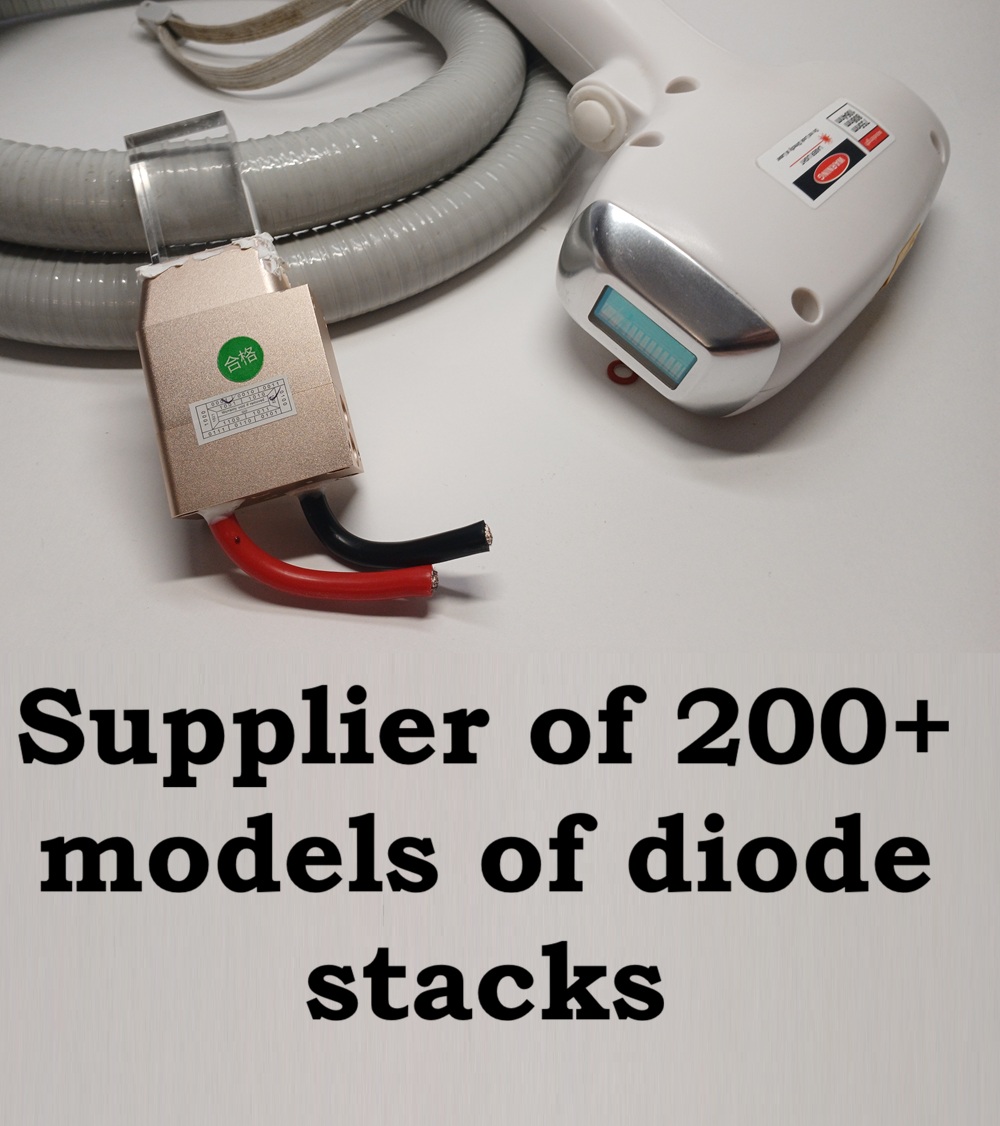
Why the prism (sapphire window) in a diode laser handpiece must be transparent? And how does this affect flashes, overheating, and overall machine problems?In an 808 nm diode laser handpiece, the "prism" is typically a sapphire window/tip (sapphire contact window).
It performs several critical functions at once:
- transmitting the laser light
- providing contact skin cooling
- protecting the internal optics
Transparency is the most important parameter because sapphire is chosen specifically for its extremely high optical transmission in the infrared range (especially at 808 nm — >95–98% transmission).Any cloudiness, scratches, contamination, or defects significantly reduce light transmission.How this affects laser performance1. On flashes and epilation effectiveness
- Clean/transparent prism: 95–98% of the beam energy reaches the skin → full fluence (J/cm²) is delivered → hair follicle heats up to 70–100°C → effective destruction of the hair.
- Cloudy/contaminated prism: 10–30% (or more) energy loss → fluence drops dramatically → weaker heating of the follicle → much poorer hair removal results (clients complain "it doesn't work").
- Severe cloudiness/scratches: up to 50%+ energy loss → the procedure becomes almost useless.
- On overheating
A non-transparent (cloudy) prism absorbs part of the laser energy instead of transmitting it → the sapphire itself starts heating up intensely (can reach 100–200°C locally).
This heat transfers to the diode stack and internal optics → accelerated wear of the stack, frequent "overheat" errors, and the machine shuts down.
In severe cases → cracking of the sapphire or destruction of anti-reflective coatings.3. Overall machine problems
- Reduced diode stack lifetime: due to energy losses the system is forced to operate at higher power → stack overheats → lifetime drops 1.5–3 times (e.g., from 10–20 million shots down to 3–5 million).
- Frequent errors and emergency shutdowns: temperature sensors detect overheating → machine blocks operation.
- Damage to internal optics: lenses, mirrors, and AR-coatings degrade faster from constant heating.
- Risk of client burns: when the prism is cloudy, energy scatters unevenly → appearance of hot spots on the skin.
Real-life examples from practice
- Light cloudiness (residue from gel): 5–10% loss → client feels less heat, weaker effect.
- Scratches/deep contamination: 20–40% loss → frequent overheating, stack lifetime drops to 3–5 million shots instead of 10–20 million.
- Completely cloudy prism: the machine "fires blanks" — almost all energy heats the handpiece instead of the skin.
How to maintain transparency
- Clean the sapphire after every procedure (alcohol + soft lint-free cloth/microfiber).
- Never use abrasive cleaners.
- Store the handpiece in a protective case.
- Replace the sapphire window when visible defects appear (cost usually ~5,000–15,000 RUB depending on model/supplier).
A transparent prism is like clean window glass: the cleaner it is — the more light (and treatment effect) gets through!If you have specific symptoms or a particular laser model — write them down, I'll give more precise advice.Romshi — manufacturer of 808 nm diode stacks
Supplier of machines and spare parts → www.romshi.com
Interesting Facts About the 808 nm Laser Beam in Cosmetology . The 808 nm wavelength is the "golden mean" for diode lasers in hair removal.
- Invisible, but "pink"
The 808 nm wavelength itself is in the near-infrared range and completely invisible to the human eye. The pink/purple color we see is from an added pilot beam (635–650 nm) for the cosmetologist's safety. - Perfect absorption balance
Melanin absorbs 808 nm about 2 times better than 1064 nm, but 2–3 times worse than 755 nm. This allows efficient heating of the hair without overheating the skin — significantly fewer burns on darker skin types. - Penetration depth — 3–5 mm
The beam reaches the hair bulb and bulge (where most hair follicles grow). 755 nm penetrates shallower (1–2 mm), while 1064 nm goes deeper (5–7 mm). - Minimal competition with hemoglobin
At 808 nm, hemoglobin (blood in vessels) absorbs almost no light — the risk of vascular reactions is minimal compared to 755 nm. - Temperature stability
The diode wavelength slightly drifts with temperature (±0.3 nm per °C). That's why high-quality lasers maintain strict water cooling at 20–25 °C — otherwise efficiency drops. - Photon energy is perfect for melanin
The energy of an 808 nm photon is ≈1.53 eV — it exactly matches the energy levels of melanin, but water starts absorbing only after 950 nm. - Why 808 nm became the standard
In the 1990s, GaAlAs diodes reached commercial maturity exactly at this wavelength — cheap, powerful, and stable. Since then, 808 nm has been the most widespread in cosmetology. - The beam "doesn't cut," it heats
808 nm is non-ablative (does not vaporize tissue) — it's coagulative. Heating to 70–100 °C causes protein denaturation in the follicle — the hair dies without blood or severe pain. - Effect on different hair colors
Works best on dark hair (high eumelanin). On red/blond hair — weaker (pheomelanin absorbs poorly). On gray hair — almost zero (no melanin). - Eye safety
808 nm is less dangerous to the retina than visible light, but protective goggles are still required — direct exposure can cause thermal damage. - Same 808 nm in industrial lasers
The same diodes are used to pump fiber lasers for metal cutting — with power up to kilowatts. - The pink color is marketing + safety
Some manufacturers make the pilot beam brighter pink so the client can "see the work" and feel more confident in the procedure.
Supplier of devices and spare parts
How Does Extra Hair Length (1 mm, 2 mm, 3 mm, etc.) Affect Laser Hair Removal?Short and to the point: The longer the hair at the time of the procedure, the worse the result and the higher the risk of side effects.
Here’s why and exactly how it works (using the most popular 808 nm diode laser in 2026 as an example).Why hair length matters
The laser operates on the principle of selective photothermolysis:
energy is absorbed by melanin in the hair shaft, heat transfers to the follicle and destroys it. If the hair is too long:
- Most of the energy is wasted heating the visible part of the hair above the skin (which will burn off or be shaved anyway).
- Less heat reaches the follicle (the most important part, located 2–5 mm deep).
- The visible hair can overheat and “explode” → small burns, redness, blisters, carbon particles on the skin.
Real impact by hair length (808 nm diode laser)
- 0–0.5 mm (shaved 12–24 hours before)
Follicle destruction efficiency: 95–100% (ideal)
Burn/side effect risk: very low
Procedure comfort: maximum
Recommendation: best option - 1 mm
Efficiency: 85–95%
Risk: low
Comfort: excellent
Recommendation: acceptable - 2 mm
Efficiency: 70–85%
Risk: medium
Comfort: worse
Recommendation: already undesirable - 3 mm
Efficiency: 50–70%
Risk: high
Comfort: discomfort
Recommendation: not recommended - 4–5 mm
Efficiency: 30–50%
Risk: very high
Comfort: very painful
Recommendation: prohibited - >5–7 mm
Efficiency: <30%
Risk: extremely high
Comfort: unbearable
Recommendation: strictly forbidden
What physically happens with extra 2–3 mm?
- Energy scatter: out of 30 J/cm², only 15–20 J reaches the follicle → you need 1.5–2 times more sessions.
- Hair “explosion”: the long shaft heats instantly → micro-explosion → hot particles scatter → 1st–2nd degree burns.
- Smoke and smell: burning hair → black smoke, burnt hair odor → unpleasant for client and technician.
- More pain: surface overheating → stronger nerve response.
Real salon recommendations (2026)
- Ideal: shave the area 12–24 hours before (0–0.5 mm stubble).
- Acceptable: 1 mm (if the client forgot to shave).
- Not recommended: 2+ mm — either the technician increases energy (burn risk) or lowers it (weak effect).
- Prohibited: 3+ mm — almost all professional protocols require pre-shaving.
One-sentence summary
Every extra 1 mm of hair above the skin reduces effectiveness by 10–20% and increases burn/discomfort risk by 30–50% — so always shave the area 12–24 hours before the session for maximum results with minimal risks.If a client arrives with 3–4 mm, it’s better to reschedule or at least quickly shave on-site (but that’s already a compromise).
Key Certificates for Cosmetic Lasers Worldwide
(Cosmetic lasers for hair removal, rejuvenation, tattoo removal, etc.)Cosmetic lasers are classified as medical devices or Class II devices (moderate risk). Certificates confirm safety, effectiveness, and quality. Here are the main ones worldwide as of 2026:
- USA: FDA Clearance (510(k))
Mandatory for sale in the United States.
Lasers receive "clearance" as Class II devices for "permanent hair reduction" (not "removal").
The FDA checks safety and effectiveness by comparing to predicate devices.
Examples: Candela GentleMax, Cynosure, Tria Laser — all have FDA clearance.
Without it — import and sales are prohibited. - Europe (EU and EEA): CE Marking
Mandatory under the MDR (Medical Device Regulation 2017/745).
Most cosmetic lasers fall into Class IIa or IIb.
Requires technical documentation, clinical data, and audit by a Notified Body (e.g., BSI, TÜV).
CE marking allows free circulation and sales in 27+ EU countries.
For purely non-medical/cosmetic devices — sometimes GPSD applies, but usually MDR is required. - Russia and EAEU: Roszdravnadzor Registration Certificate (RU)
Mandatory for Russia, Kazakhstan, Belarus, etc.
Lasers are classified as medical devices and require RU registration (similar to full approval).
Plus EAEU Declaration/Certificate of Conformity (TR CU).
Without RU — fines and sales ban. - China: NMPA (formerly CFDA) Registration
Required for the local Chinese market.
Many manufacturers (Weifang KM, Nubway, etc.) hold it. - Other countries
- Canada: Health Canada Medical Device License
- Australia: TGA (Therapeutic Goods Administration) — ARTG listing
- Brazil: ANVISA registration
- South Korea: KFDA/MFDS approval
- Japan: PMDA approval
- International quality standards (voluntary but build trust)
- ISO 13485: Quality Management System for medical devices
- IEC 60825-1: Safety of laser products (international standard)
- ANSI Z136: Laser safety standard (mainly for the USA)
Recommendations before purchasing
Always check:
- FDA 510(k) database (fda.gov)
- EUDAMED database (for CE marking)
- Roszdravnadzor registry (for RU)
For import into Russia — RU from Roszdravnadzor is mandatory; CE and/or FDA are big advantages.
Many Chinese lasers have CE and ISO, but verify authenticity — there are many fakes. If a device lacks key certificates — risks include fines, seizure, and no warranty/support.If you need details on a specific model — feel free to ask! Romshi — manufacturer of 808 nm diode stacks
Supplier of devices and spare parts
www.romshi.com
+79180110234
Shipping from China
#certificates #cosmeticlasers #romshi
Страница 2 из 7
- Вы здесь:
-
Главная

- Expert ROMSHI talks about lasers