

Expert ROMSHI talks about lasers
Godzilla in 2026 is no longer doomed to remain forever a walking mountain of armored scales and radioactive tan.Modern cosmetology, lasers, and regenerative technologies can seriously bring him closer to the image of a "charismatic giant macho with perfect skin."First, we tackle the thickest, stone-like scales.
They can be significantly softened and thinned using very aggressive keratolytics (50% urea + acids) applied daily at home, plus several sessions of deep fractional CO₂ or erbium laser.
It's painful, with a long recovery period, but the most massive plates can realistically become thinner and softer after a year and a half.Next — texture.
The rough, abrasive, "prehistoric" skin can be made much smoother and more elastic.
State-of-the-art multi-level fractional lasers (such as HALO, UltraClear), powerful RF-microneedling, and combinations with HydraFacial work wonders here.
After 8–15 procedures, the surface stops resembling asphalt after a nuclear explosion.Hyperpigmentation — the black-gray, almost charcoal shade — is one of the most rewarding areas.
Pico-lasers (PicoSure Pro, PicoWay) and Q-Switched lasers excellently shatter this deep melanin.
After 6–12 sessions, Godzilla shifts from black-gray to a more noble dark gray with a sophisticated graphite sheen.Pores, unevenness, and overall relief are also manageable:
RF-microneedling combined with biorevitalization using peptides and exosomes dramatically tightens pores and brings back at least some hint of smoothness and radiance to the skin.The most realistic scenario over 18–30 months of dedicated work looks something like this:
- First, one or two months of at-home "softening" of the scales
- Then several heavy laser resurfacing sessions on the thickest zones
- Main course of pico-lasers for lightening
- Followed by a wave of RF and fractional procedures for texture
- Final stage with injections of growth factors and exosomes for restoration and glow

What could modern cosmetology offer the Yeti (Snowman) in 2026?Imagine the legendary Yeti finally descending from the mountains, booking an appointment at a premium salon, and deciding it's time to tame that legendary thick fur.
- Full-body laser hair removal (diode laser 808 nm + Nd:YAG 1064 nm)
The Yeti is basically one big ball of dense fur. A tri-wavelength laser can handle even the thickest, deepest hairs. After 10–12 sessions, significant thinning is possible — turning the Yeti into a "lite" version of himself and stopping him from leaving fur on every tree in the Himalayas. - Carbon peeling + Q-Switched Nd:YAG
Deep cleansing of pores hidden under thick fur and evening out skin tone (likely pale from eternal snow). Removes dead skin flakes, leaving the skin smooth and radiant — the Yeti is now ready for selfies with alpinists. - Cryolipolysis (CoolSculpting)
If the Yeti has packed on some "winter insulation" fat — cryotherapy will target and eliminate localized deposits without surgery. The Yeti becomes more athletic and can outrun curious tourists even faster. - HIFU (SMAS-lifting)
Ultrasound face and neck tightening to remove sagging skin under the thick fur and sharpen the jawline contour. The Yeti will look simultaneously younger and more intimidating. - RF-microneedling with gold needles
Deep collagen stimulation to firm the skin and reduce scars from old bear fights. Bonus: improved fur texture in growth zones. - Plasma therapy (Plasma Pen)
Removal of warts, papillomas, and other "mountain" skin growths. The Yeti returns to his cave with perfectly clear skin. - LPG massage and VelaShape
Lymphatic drainage and anti-cellulite treatment for that massive body — improves circulation and reduces swelling after long snow naps. - LED phototherapy (red + blue light)
Red for healing and collagen boost, blue against possible inflammation. The Yeti gets a healthy glow even under the fur. - Mesotherapy with vitamins and hyaluronic acid
Hydration and nourishment for skin in the dry mountain air — no more winter flaking for the Yeti. - Permanent makeup for brows and eyes
To accentuate those expressive Yeti eyes and make the gaze even more mysterious (yes, even snow creatures want to look stylish).
The main challenge? Finding a salon with a reinforced treatment bed and a huge stock of laser gel! If the Yeti is ready to book — contact Romshi for professional equipment tailored for such extraordinary clients!
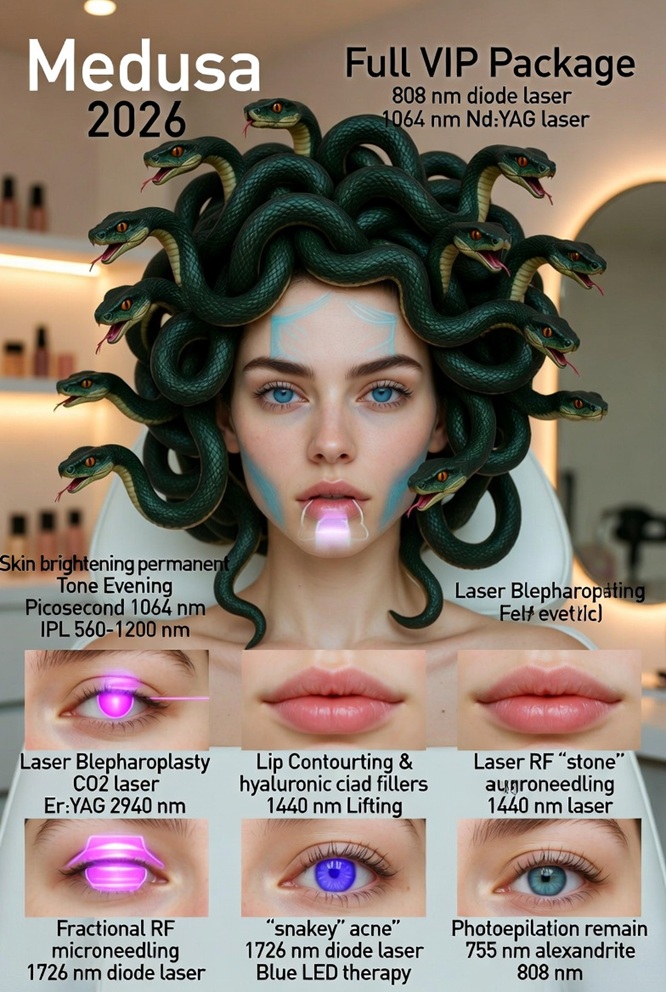 What can modern cosmetology do for Medusa the Gorgon? (Theoretically, of course — but using the most cutting-edge procedures of 2026)
Medusa Gorgon is a classic: snakes instead of hair, a petrifying gaze, and the eternal hairstyle nightmare. Let’s break down what the current arsenal of advanced cosmetology (lasers, RF, injections, hardware treatments) can realistically do so that Medusa can finally feel confident and beautiful.
- Complete and permanent snake-hair removal
Total elimination of all snakes from the head.
808 nm diode laser + 1064 nm Nd:YAG in combo mode
• Energy 40–60 J/cm², long pulse 100–150 ms
• 8–12 sessions
Result: perfectly smooth scalp skin, just like a model after a Hollywood Brazilian keratin treatment. No more crawling snakes — only memories remain. - Laser skin brightening & tone evening
Removing the greenish-gray undertone and creating an even complexion.
Picosecond 1064 nm + IPL 560–1200 nm
• Photorejuvenation + fractional CO2
Result: porcelain, glowing skin without any “snakey” undertone. - Laser blepharoplasty of the eyelids
Eliminating hooding and heaviness of the eyelids that create the “sinister” look.
CO2 laser or Er:YAG 2940 nm in ablative mode
Result: open, expressive eyes — the gaze remains dangerous, but now seductive rather than deadly. - Lip contouring & augmentation
Adding volume and sharp definition — so the lips look sexy instead of threatening.
Hyaluronic acid fillers + laser RF contour lifting
Result: plump, juicy lips you’d want to kiss (if you dare). - Removal of the “stone” effect on the face
Fractional RF microneedling + 1440 nm laser.
Breaking down “petrified” areas and stimulating collagen production.
Result: soft, elastic skin without that concrete-like sensation. - Treatment of “snakey” acne and inflammation
1726 nm diode laser (dedicated acne laser) + blue LED therapy.
Clearing inflammation on scaly areas of the neck and cheeks. - Photoepilation of remaining scales and eyelashes
755 nm alexandrite + 808 nm for precise spot treatment.
Result: smooth cheeks and perfect lashes without any “snake” vibes. - Full VIP package “Medusa 2.0”
Sessions 1–3: snake removal + skin brightening
• Sessions 4–6: face lifting + lip contouring
• Sessions 7–9: skin resurfacing + RF rejuvenation
• Finale: collagen injections + LED therapy
Final outcome: from a terrifying Gorgon to a fatal beauty who makes men fall — not from her gaze, but from pure admiration.Now Medusa can go on dates without turning anyone to stone. The only thing left is to warn her date:
“I just came from the cosmetologist, so… don’t stare too long, or you’ll fall in love to death.”
What could theoretically be done with a Tyrannosaurus using cosmetic lasers? Let's fantasize as creatively as possible with a scientific twist (808 nm, 1064 nm, CO2, picosecond, and other beauties). Of course, it's all purely hypothetical—a Tyrannosaurus weighing 7–9 tons and standing 12 meters tall isn't exactly your typical salon client.
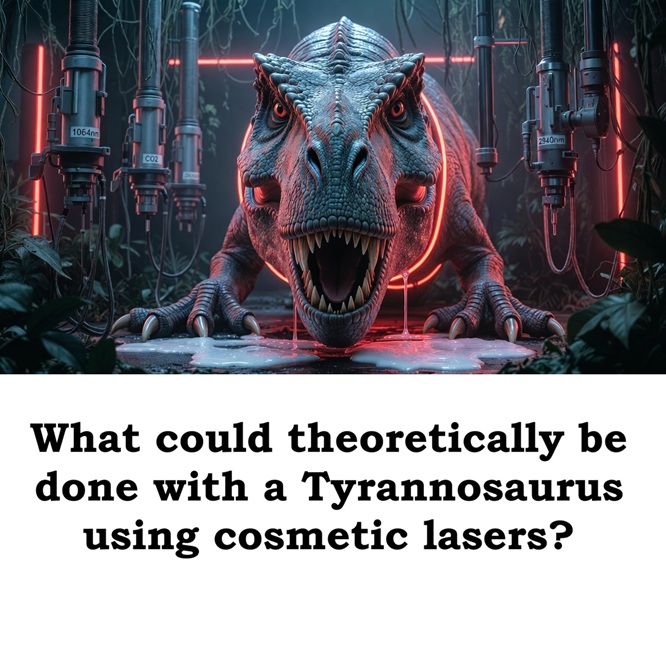
Here are 20 options, from almost realistic to complete absurdity:
- Smooth skin without scales
Mass removal of feathers/scales across the entire body. 1064 nm + huge 40×40 mm spots + energy 80–120 J/cm². The Tyrannosaurus becomes the smoothest predator of the Cretaceous period. - Teeth whitening
Laser whitening gel + 445–532 nm (green/blue range). After 3 sessions, the teeth are like a Hollywood star's—15-centimeter snow-white fangs. - Laser wrinkle lifting on the face
Fractional CO2 or Er:YAG 2940 nm. Remove age grooves around the eyes and mouth. T-Rex looks 10 million years younger. - Removal of pigment spots and battle scars
Picosecond 1064 nm or Q-Switched. All old scars from Triceratops and wounds from rivals—gone as if they never existed. - Laser hair removal for mustache and "beard"
808 nm with 50 J/cm² on the toughest vibrissae. Now the mouth is clean, without "hairy" interference when roaring. - Pore reduction on the nose
Neodymium 1320 nm in FRAC mode. Nostrils the size of plates become more aesthetically pleasing. - Acne treatment on the back
1450 nm diode or 1726 nm (Acne Laser). Farewell to inflammations from Jurassic dirt. - Tattoo removal (if some paleo-rocker got "Rex Rules" inked)
Picosecond 755/1064/532 nm. Complete removal in 6–10 sessions. - Laser claw polishing
CO2 laser in ablation mode. Claws become perfectly smooth and sharp—T-Rex level manicure. - Photo-rejuvenation of the entire hide
IPL or 560–1200 nm. The skin acquires a more even gray-green tone without spots. - Snoring treatment (if it snores after a heavy Triceratops meal)
Laser snoring therapy for the soft palate (1064 nm). The Tyrannosaurus finally sleeps quietly. - Tongue volume reduction
Laser resection + RF-lifting. So the tongue doesn't hang out of the mouth. - Laser posture correction
Myofascial RF + 1064 nm. So it doesn't slouch like an old lizard. - Hair removal on the inner surface of the mouth
808 nm with a flexible tip. Now meat doesn't get stuck in the teeth or on the tongue.- Laser callus removal on the feet
CO2 ablation. After millions of years walking on rocks—smooth soles. - Dandruff treatment (if feather follicles remain)
1550 nm fractional laser. Scales go away, head is clean. - Laser blepharoplasty for eyelids
CO2 or Er:YAG. Remove eyelid overhang—the gaze becomes even more intimidating. - Laser contouring of cheekbones
RF-microneedles + 1440 nm. Make the cheekbones even more predatory and defined. - Laser removal of "double chin"
1064 nm lipolysis + HIFU. Even a 9-ton lizard can have a "dewlap"—we remove it. - Full "VIP package"—Tyrannosaurus after a spa day
Smooth skin, snow-white teeth, tightened neck, clean pores, perfect claws, no snoring, and fresh breath.
Result: The most stylish, confident, and dangerously beautiful T-Rex in history.
In theory—almost everything we do to people can be scaled up for a Tyrannosaurus.
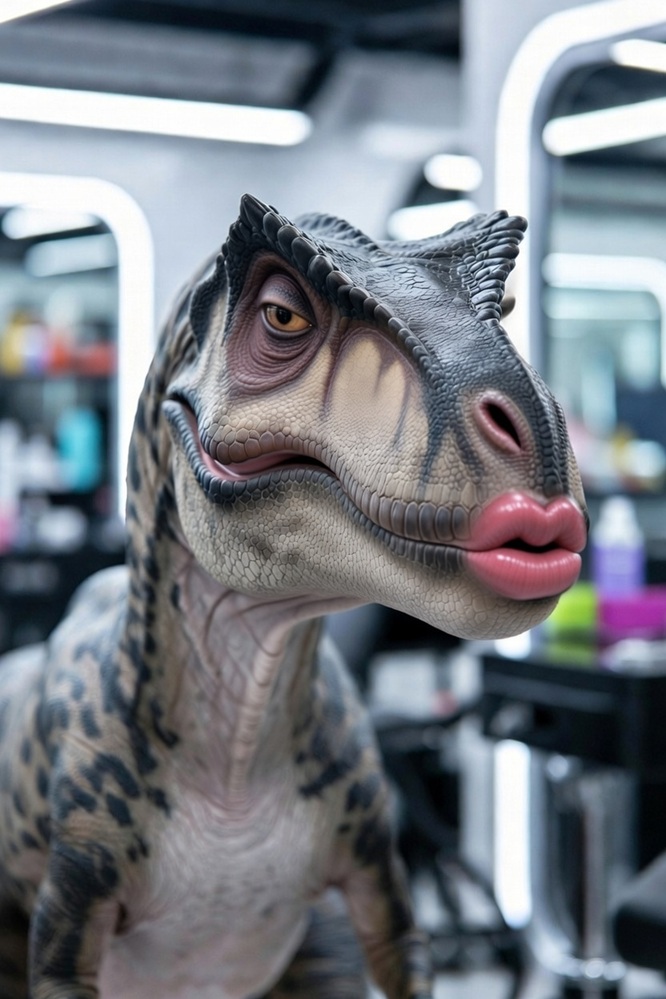
You'll just need a very large handpiece, 500-liter gel, and insurance for 100 million dollars. Which point did you like the most?As for me, I particularly enjoyed point 3—the laser wrinkle lifting to make the T-Rex look 10 million years younger. It's got that perfect blend of absurdity and a clever nod to paleontology!
What speed does light travel from the diode stack to the patient's skin?Light from the diode stack in a cosmetology laser (808 nm) is electromagnetic radiation, and its speed in vacuum and air is practically the same.Speed of light = 299,792,458 m/s
(approximately 300,000 km/s).What does this mean in practice?
- The distance from the diode stack to the patient's skin in the handpiece is usually 5–15 cm (inside the optical system: bars → lenses → sapphire window → skin contact).
- Time for light to travel this distance:
10 cm = 0.1 m → time = distance / speed = 0.1 / 299,792,458 ≈ 0.00000000033 seconds (0.33 nanoseconds).
In essence — instantaneously. The light reaches the patient's skin with virtually no delay.Why is this important to know?
- The entire effectiveness of hair removal depends not on the speed of light (it's always maximum), but on energy density (fluence), pulse duration, and cooling.
- Light doesn't "travel slowly" — it reaches the follicle in fractions of a nanosecond, while heating occurs in milliseconds (pulse duration 10–400 ms).
Fun fact: If you could see a laser pulse in slow motion, it would travel from the handpiece to the skin faster than you can blink (a blink is ~0.1–0.4 seconds).If you have calculations for a specific laser model — let me know!Romshi — Manufacturer of 808 nm Diode Stacks
Supplier of Laser Hair Removal Machines & Spare Parts www.romshi.com
If You Replace the Laser Spot from 1 cm x 1 cm with 1 m x 1 m:What Happens to Energy Density and the Effect on the Body/Hair?
Interesting question! In laser hair removal, the standard "window" (spot) of the handpiece is an area of ~1–2 cm² (1 cm x 1 cm = 1 cm²). If you increase it to 1 m x 1 m (area 10,000 cm²), it's like trying to "epilate" an entire room with one pulse. Let's break it down scientifically (physics + cosmetology), without formulas but with calculations.1. How Does Energy Density (Fluence) Change?Fluence is the energy of the laser pulse per unit area, measured in J/cm². For effective hair removal, you need 20–60 J/cm² — this heats the follicle to 70–100°C without damaging the skin.
With a standard spot (1 cm²), all the pulse energy (say, 30 J) is concentrated in a small area → fluence 30 J/cm².
With a huge spot (10,000 cm²), the same energy spreads over a gigantic area → fluence drops 10,000 times (to 0.003 J/cm²). It's like spreading a spoonful of honey over a football field — density approaches zero.
Result: The laser beam becomes "diluted" — the energy is too weak to heat the melanin in the hair.2. Effect on the Human Body and Hair
On hair: No effect at all. Destroying the follicle requires focused energy — here it's too scattered. The hair won't even warm up, and hair removal won't work. At most — slight warmth, like from the sun.
On skin and body: Minimal. At such low density, the risk of burns/side effects is zero — energy is evenly distributed, like weak infrared light. But there's no benefit either. If the laser is powerful (industrial type), it could cause mild heating of a large area, but for cosmetology, it's useless and dangerous (scattered beam can damage eyes from a distance).
Creative example: Imagine "epilating" a crowd at a concert with one flash — no one would notice except a slight "warming." But for a salon, it's absurd — the procedure would take a second, but with zero results.In reality, such huge spots are not used in cosmetology — the optimal is 1–2 cm² for precision.If you have specific symptoms or a model — write, I'll advise more precisely!Romshi — Manufacturer of 808 nm Diode Stacks
Supplier of Laser Hair Removal Machines & Spare Parts
Diode lasers for hair removal (808 nm) are equipped with powerful cooling systems (water + air + semiconductors), so they are quite resistant to dust. But dust is one of the main enemies that cause overheating. It clogs ventilation grilles, filters, and radiators, blocking airflow and heat dissipation.When does overheating from dust begin?
Light dust (regular room with daily cleaning) — almost no problems. The laser works fine for months.
Medium dustiness (room without regular cleaning, construction nearby, or high client traffic) — after 1–3 months, the first signs may appear: the laser heats up faster, the fan gets louder, errors like "overheat" possible.
Heavy dust (room uncleaned for weeks, visible dust on surfaces, no filters or they are clogged) — overheating can start in just 2–4 weeks of intensive use. The device shuts down for protection, power drops, risk of damaging the stack or handpiece.
Real examples from practice and manufacturer recommendations:
If filters haven't been cleaned for 3–6 months — chronic overheating, stack resource drops by half.
In a dusty room (like "construction dust" or no air conditioning) — overheating is possible even with a clean device, because dust settles on optics and absorbs laser energy.
How to avoid it
Clean external grilles and filters weekly (vacuum + compressed air).
Full internal cleaning — every 1–3 months (or per manual).
The room must be clean: daily wet cleaning, air conditioner with filters, cover the device when not in use.
The room doesn't need to be "extremely dusty" — even moderate dust will kill the laser over time. Regular cleaning — and the device will last years without overheating.Yes, the effect of dust on heat dissipation in electronics (including laser equipment) is not just "clogs ventilation," but a whole set of interesting and sometimes unexpected effects. Here are some cool facts based on research and practice (including for cosmetology lasers):
Dust as a "thermal blanket": A layer of dust just 1–2 mm thick reduces heat dissipation by 20–40%. It acts as an insulator (dust thermal conductivity ~0.02–0.1 W/m·K, vs 200+ for copper in radiators). In lasers, this leads to diode stack overheating — temperature rises 10–20°C faster.
Temperature increase by 15–30°C: In computers and similar electronics, dust on radiators raises CPU/GPU temperature by 15–30°C. Same in diode lasers: stack overheating shortens flash resource 2–3 times (from 10–20 million to 3–5 million).
Dust + humidity = conductor: Dry dust is a dielectric, but with moisture (even 20–30% room humidity) it becomes a semiconductor. Can cause shorts or current leaks, especially in power supplies.
Reduced fan efficiency: Dust on blades increases motor load — fan louder but less effective (airflow drops 30–50%). Critical for handpiece cooling in lasers.
Thermal runaway: In extreme cases, dust causes "thermal runaway" — components heat up, dust heats more, conductivity rises — cycle to failure.
In industrial lasers: Dust on optics (lenses, mirrors) absorbs the beam — local heating to 100–200°C, cracks or coating damage.
0.5 mm dust layer = +10°C: Experiments show even a thin layer on heatsink raises temperature 5–15°C, thick — up to 50°C.
Dust accelerates corrosion: With moisture, causes contact oxidation, worsening heat transfer from chips.
Romshi — Manufacturer of 808 nm Diode Stacks
Supplier of Laser Hair Removal Machines & Spare Parts www.romshi.com
+79180110234 Sale Laser Spare Parts. Shipping from China
Страница 5 из 7
- Вы здесь:
-
Главная

- Expert ROMSHI talks about lasers