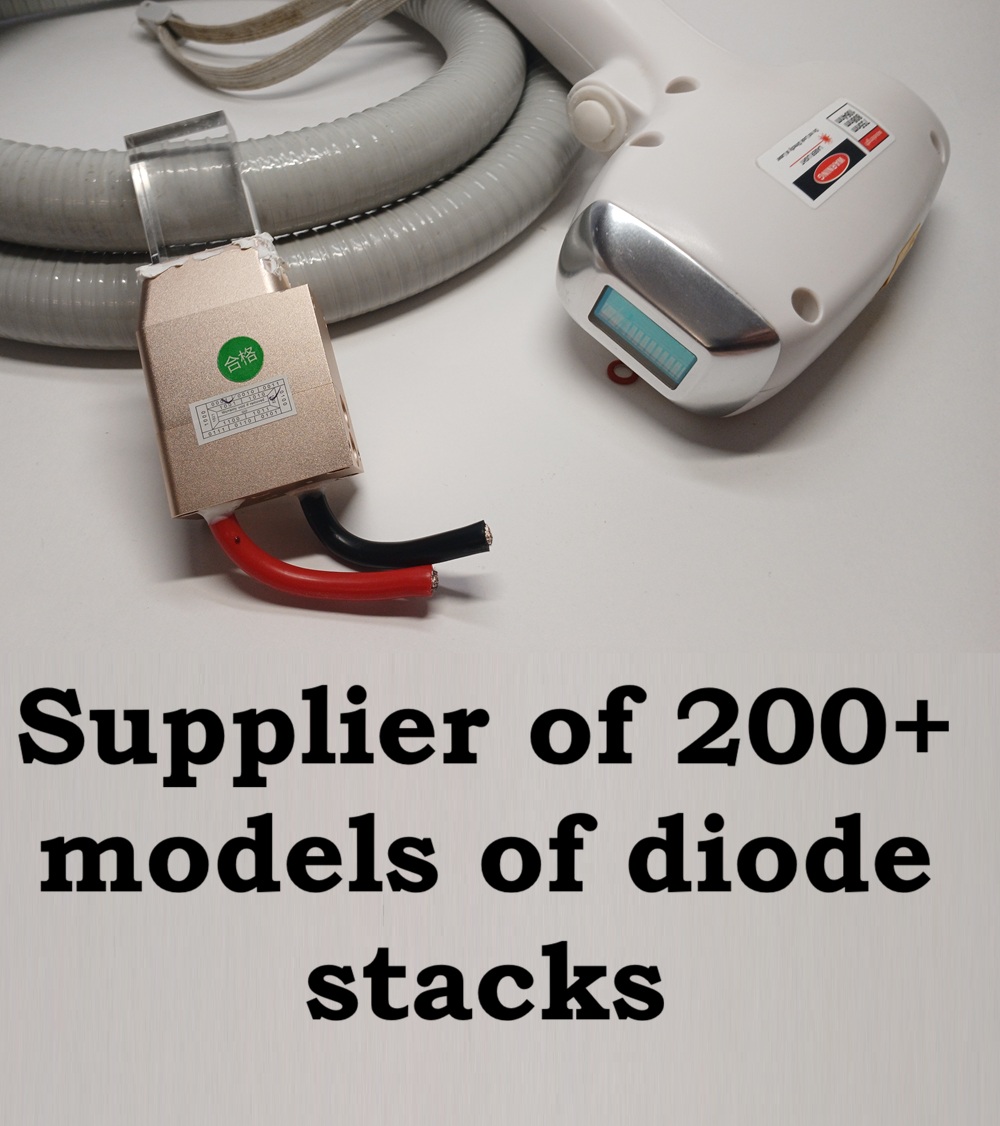
The resource isn't about the device "suddenly failing on the 10,000,001st shot."The claimed lifespan of a diode stack at 10–20 million shots (and in some models even 50–100–200 million) is indeed based on accelerated laboratory tests conducted by manufacturers.
These tests are performed under ideal conditions:
- Constant diode active zone temperature of ~20–25°C.
- Minimal pulse power (low fluence, e.g., 10–20 J/cm² instead of the real 30–40 J/cm² needed for effective hair removal).
- Low repetition rate (1–2 Hz, not 10 Hz in "in-motion" mode).
- Perfect cooling (deionized water, no impurities, constant flow).
- No dust, vibrations, or power surges.
- Thermal expansion and mechanical stress: The diode materials (GaAs/AlGaAs) and solder (often indium or gold-tin) have different expansion coefficients. Heating/cooling cycles cause micro-cracks, especially on the facets (output mirrors). This leads to catastrophic optical mirror damage (COMD) — sudden "burnout" of the facet.
- Defect diffusion: Point defects (vacancies) migrate under heat and current, forming dark line defects (DLD) — dark lines that absorb light and further accelerate degradation.
- Facet oxidation: Even with protective coatings (AR/HR), facets oxidize over time, increasing losses and reducing output power.
- Overheating from intensive use: In salons, devices run 8–12 hours a day at high frequency (5–10 Hz for "fast" epilation). This raises average diode temperature by 10–20°C, exponentially accelerating degradation (Arrhenius model: doubling temperature cuts lifetime by 2–4 times).
- Optics and sapphire window contamination: Dust, gel, skin oils reduce light transmission, forcing diodes to run at higher current to compensate — direct path to overheating.
- Cooling quality: Cheap devices use basic TEC (Peltier) or macro-channels — tip temperature +5...+10°C instead of -4...-10°C in premium. Plus, water gets contaminated over time (ions, corrosion), reducing heat dissipation.
- Power surges and improper on/off: Without soft start, current spikes kill diodes instantly.
- High power for results: To achieve visible effects on dark hair, operators max out energy — this overdrives diodes, halving lifespan.
- No standard for "effective lifespan" (power ≥80% of initial).
- Claims like "100 million shots" often for low power or single bars, not the full stack in epilation mode.
- Manufacturers (especially Chinese) test at minimal parameters to make numbers look impressive.
- Cheap diode bars: Instead of quality AuSn (gold-tin) stacks, they use outdated indium-based ones that degrade faster. For example, claim 1000–1200 W, but real is 500 W with overclocking — kills the stack in months.
- Weak cooling and power supply: Instead of large capacitors (44,000 µF for stable power), powerful fans and heatsinks, they use minimal (30,000 µF, fewer fans). Leads to overheating, low power, and lifespan of 100–300 thousand shots instead of millions. For IPL (sometimes disguised as diode lasers), they use local Chinese lamps instead of UK xenon — lifespan drops from 1 million to 100–300 thousand.
- Fake specs: Sellers advertise "10 million shots," but it's for non-channel designs (no micro-channels), which can't handle intensive use. The machine "works," but with zero effect — hair doesn't remove.
- COMD and Dark Line Defects: The "Invisible Killers" of Diodes
One of the main causes of sudden diode bar death is Catastrophic Optical Mirror Damage (COMD) — the facet (output mirror) overheats and literally "burns" from its own light, triggering a chain reaction. There's also Dark Line Defects (DLD) — dark defect lines in the crystal that grow over time, absorbing energy and speeding up degradation. - Micro-Channel vs. Macro-Channel Cooling: Why the Lifespan Difference Is 5–10 Times
Most budget devices use macro-channel cooling — simple wide water channels, cheap to produce. Premium (with Coherent or Jenoptik bars) use micro-channel: thousands of tiny channels directly under the diodes, removing heat 5–10 times more efficiently.
Result:
- Macro-channel: often 1–5 million effective shots, faster overheating.
- Micro-channel: 20–50 million+, diodes last longer even under heavy load.
- Degradation Graph: How Power Drops "Quietly"
Marketing claims "10–100 million shots to failure," but power degrades gradually. Typical graph: 20% drop after just 20–30% of claimed lifespan. - Temperature Factor: +10°C = 2–3 Times Less Lifespan
Per the Arrhenius rule (semiconductor physics): +10°C diode temperature doubles degradation rate. Quality stack at 23–25°C gives 20–30 million shots; at 35–40°C (common in hot salons or poor cooling) — 2–3 times less. - Coherent vs. Chinese Bars: Real Numbers from Manufacturers
American Coherent bars (AuSn solder, micro-channel) in premium devices truly hold >20–50 million shots with minimal degradation. Chinese copies (often indium) claim the same but in practice drop noticeably after 1–5 million. In 2024, Coherent released dual-junction bars at 200 W — twice as efficient as old ones, with lower current and heat. - Bonus Fact: "Unlimited Shots" in New Models
Some modern devices (fiber-coupled diode) claim "unlimited shots" — fiber reduces losses, cooling is better. But it's still marketing: degradation exists, just slower.