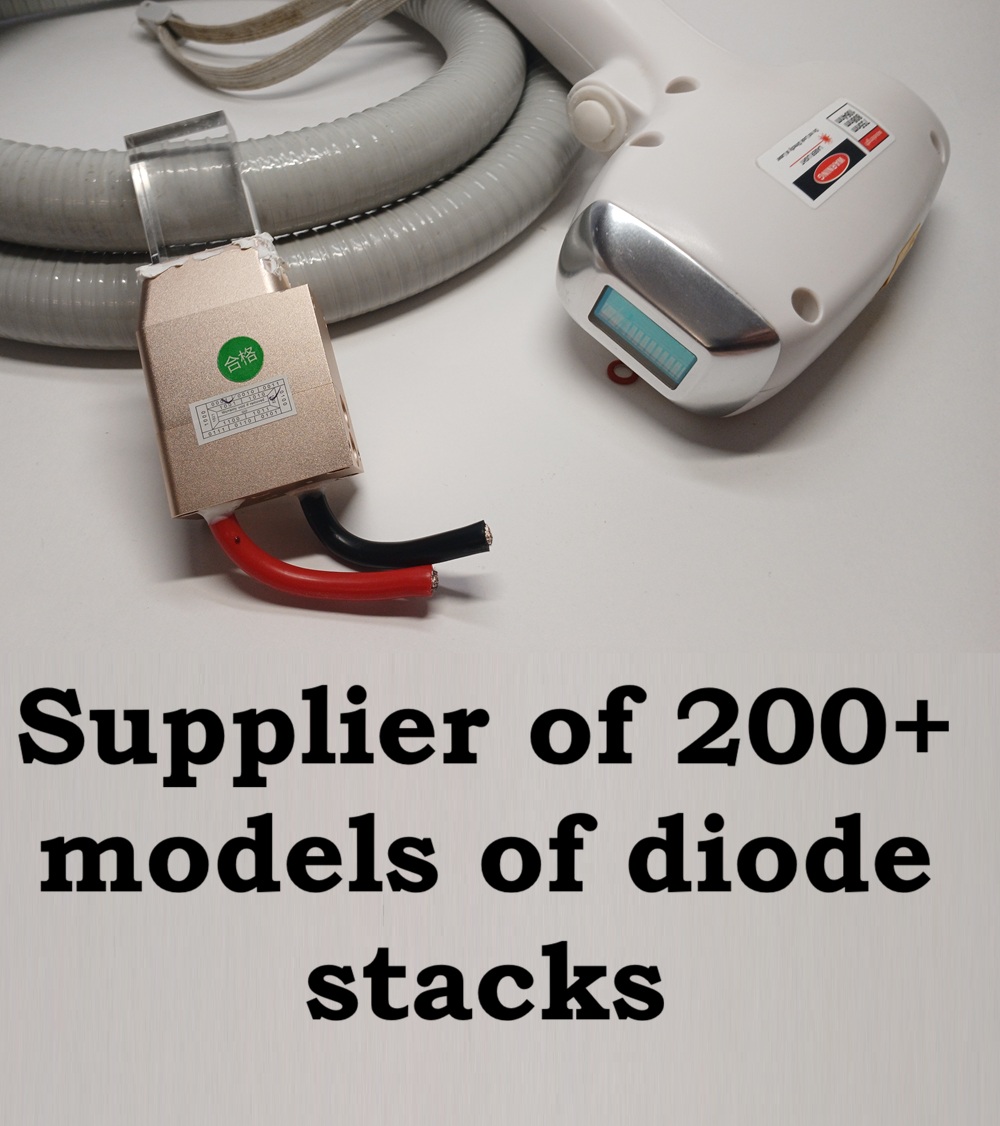
How the Diode Stack (Bar Stack) Degrades Over Time in a Cosmetic 808 nm LaserThe diode stack (also called diode bar stack) is the heart of an 808 nm laser system.
It usually consists of 10–60 laser bars, with each bar containing 10–40 individual diode emitters made from GaAs/AlGaAs semiconductors.
Degradation is the gradual loss of output power and efficiency caused by various physical and chemical processes. Manufacturers typically claim a lifetime of 10–30 million shots, but in real-world conditions the actual useful life is usually 5–20 million shots, depending heavily on quality and operating conditions.Main Mechanisms of Degradation
Degradation is inevitable — it’s the fundamental physics of semiconductor devices.
However, with proper operation and maintenance, a good-quality diode stack can deliver 15–20 million shots with acceptable performance (losses <20–25%). If you’re already seeing specific signs of degradation (uneven spot, sudden power drop, overheating errors, etc.) — describe the symptoms and I’ll help you diagnose what’s most likely happening!
Degradation is the gradual loss of output power and efficiency caused by various physical and chemical processes. Manufacturers typically claim a lifetime of 10–30 million shots, but in real-world conditions the actual useful life is usually 5–20 million shots, depending heavily on quality and operating conditions.Main Mechanisms of Degradation
- Thermal Degradation (most common, 60–70% of cases)
- Each pulse heats the diodes to 50–80 °C.
- Repeated heating/cooling cycles create thermomechanical stress → micro-cracks in the active region, dislocations in the crystal lattice.
- Result: quantum efficiency drops → power decreases by approximately 0.1–0.5% per million shots.
- Electromigration and Contact Degradation
- High current (up to 100–200 A per bar) causes metal atoms (indium, gold) to migrate in the contacts.
- Voids (empty spaces) and “whiskers” form → electrical resistance increases, leading to localized overheating.
- Result: individual emitters fail (“burn out”), the bar loses power unevenly → dark lines or uneven spots appear in the treatment beam.
- Catastrophic Optical Damage (COD)
- Extremely high optical power density at the diode facet causes local melting or oxidation.
- Starts with “dark line defects”, then sudden complete failure of the bar.
- Most common when current is exceeded or cooling is inadequate.
- Degradation Related to Cooling System
- Condensation inside microchannels (poor sealing) → corrosion.
- Contaminated/distilled water → reduced heat transfer → accelerated thermal degradation.
- Photochemical Degradation
- UV component of the laser’s own emission slowly breaks chemical bonds in the active layer.
- A relatively slow but cumulative process.
- 0–5 million shots: Almost unnoticeable (<5% power loss).
- 5–10 million shots: Power drops 10–20% → you need to increase energy settings to achieve the same clinical effect.
- 10–15 million shots: Losses 20–40% → beam becomes visibly uneven (dark lines/stripes), clients start complaining about weaker results.
- 15+ million shots: Losses >50% → multiple dead bars, frequent overheating, error messages, handpiece becomes unreliable.
- Overheating (poor cooling, dust buildup, high room temperature).
- Operating above recommended current/energy settings.
- Frequent on/off cycles (especially without proper warm-up/cool-down).
- Low-quality diode bars (cheap Chinese “no-name” vs reputable brands like Coherent, nLight, Jenoptik).
- Keep cooling water temperature stable at 20–25 °C.
- Perform regular cleaning of the handpiece, filters, and cooling system.
- Never exceed the manufacturer’s recommended energy/current limits.
- Choose high-quality stacks (macro-channel designs are generally more forgiving than micro-channel in non-ideal conditions).
Degradation is inevitable — it’s the fundamental physics of semiconductor devices.
However, with proper operation and maintenance, a good-quality diode stack can deliver 15–20 million shots with acceptable performance (losses <20–25%). If you’re already seeing specific signs of degradation (uneven spot, sudden power drop, overheating errors, etc.) — describe the symptoms and I’ll help you diagnose what’s most likely happening!